
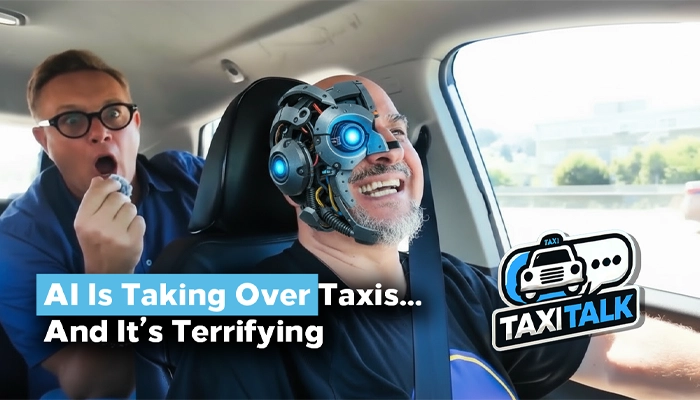
“Did you see that? There’s no one inside!”
That’s how this episode of Taxi Talk kicks off — with a driver pointing and laughing as a Waymo car glides silently past. The sight of an empty car driving itself through San Francisco still stops people in their tracks.
This was the moment host Dave realised he had arrived in the birthplace of transport disruption — the city that gave the world Uber, and now the rise of AI behind the wheel.
The Road to the Birthplace of Disruption
San Francisco has always been a city of firsts. It’s where the taxi met technology head-on, and where Humans and machines now share the road. Dave began his journey at the Flywheel depot, where he met Salman, a cheerful veteran taxi driver who’s been on the road since the 1980s.
Salman has seen it all — the pre-Uber golden age, the chaos when ride-hailing apps took over, and now the quiet arrival of driverless cars. Yet, he doesn’t sound bitter. In fact, he grins and says, “The Waymo car doesn’t scare me — it’s just another thing on the road.”
A Chat About Change
The two cruise past the steep hills of San Francisco, chatting about fuel prices, parking headaches, and the high cost of living. But the conversation always returns to one topic — AI.
“Everyone thinks the AI cars will take our jobs,” Salman says. “But they’re not taking taxi customers — they’re taking Uber’s.”
His logic is simple. Waymo users tend to be tech enthusiasts or tourists who already use apps. Local passengers, especially regulars, still prefer Humans. They like to chat, ask for recommendations, or just have someone who understands the city’s traffic quirks.
That human touch, Salman says, is something AI can’t replicate.
AI, Waymo Cars, and the Human Factor
The Waymo car represents the polished future of mobility — sensors spinning, data whirring, and precision driving that never breaks a rule. But as Salman points out, it’s not perfect.
He laughs, recalling a scene where a Waymo car froze in the middle of an intersection, unsure whether to move or wait. “It’s smart,” he says, “but not street-smart.”
That’s the difference between AI and Humans. One follows the code. The other feels the road.
And this theme runs through the whole Taxi Talk episode — technology can drive progress, but people still steer the experience.
Lessons from Uber’s Disruption
Before Waymo, it was Uber that rocked San Francisco’s taxi world. Medallions that once sold for £200,000 collapsed in value almost overnight. Many drivers left the industry. But for others, it became a wake-up call.
Salman calls that era “painful but necessary.” It forced taxi firms to modernise, adopt apps like Curb and Flywheel, and rethink customer service. Today, even Uber itself partners with some taxi networks — proving that Humans and AI can work better together than apart.
Taxi Talk Meets the Tech Corridor
As the Taxi Talk crew drives past the headquarters of Uber, Lyft, and OpenAI — the makers of ChatGPT — Dave reflects on the irony. A city once full of cab stands is now full of servers, startups, and self-driving prototypes.
And yet, taxis still roll on. Many now accept app bookings, take digital payments, and compete with AI using something no algorithm can code — empathy.
It’s a quiet reminder that the future of transport isn’t just about software. It’s about stories, people, and connection.
A City of Contrasts
Later, Dave meets Chris from Yellow Cab of San Francisco. Chris explains how his fleet has adapted — integrating with Uber’s system so passengers can order a yellow cab directly through the Uber app.
It’s a perfect example of Humans and AI working together. Instead of fighting change, they’re using it to build a smarter, fairer system.
Chris points out that AI might change driving, but it doesn’t end it. “You still need people who understand customers,” he says. “A robot doesn’t know when someone’s had a long day.”
The Human Edge in an AI World
That insight sums up what this Taxi Talk story is all about. AI can guide, calculate, and predict — but Humans connect, react, and care.
It’s not a war between AI and Humans. It’s a partnership.
Every revolution brings fear before acceptance. When the first cars replaced horse-drawn cabs, people panicked. When GPS arrived, drivers thought they’d lose their edge. But what happened? Drivers adapted — and thrived.
Lessons from the Road
So, what can we learn from San Francisco’s streets?
- Change is constant — adapt early.
- AI is powerful — but empathy is priceless.
- Humans and machines can work together — not compete.
- Support matters — companies like Take Me keep the wheels turning.
The future of transport won’t be all code or all conversation. It’ll be both.
As Dave says in the final moments of Taxi Talk, watching a Waymo car glide past a traditional taxi:
“It’s not man versus machine. It’s man with machine — that’s how we move forward.”
Take Me: Backing the People Who Drive the World
As the episode wraps up, the message is clear — progress doesn’t have to mean replacement. It can mean support, collaboration, and opportunity.
That’s why companies like Take Me are so important. Take Me stands beside drivers, helping them grow in a changing industry. The company champions professional taxi services, offers user-friendly booking tools, and ensures customers always get a reliable, friendly ride.
In a world of automation, Take Me reminds us that people still matter most.